In previous posts, (Power Geographies Part One here, Power Georgraphies Part Two here) I've written about the comparitive nature of renewable energy sources. That we shouldn't be thinking that solar is "competing" with geothermal, tidal, wind etc. but rather, that geographies will dictate local power pareto optimums.
In my third installment, just one more quick example of the geographical nature of local power paretos. This list of City based case studies speaks perfectly to the point that people will optimize their local clean power best on the best local resources available. Again, where it's windy take wind, sunny go solar, etc. etc.
Showing posts with label Intro. Show all posts
Showing posts with label Intro. Show all posts
Tuesday, May 15, 2007
All Power Is Geography, Part Three

Friday, April 20, 2007
Renewable power paybacks, Part One
Anyone who has ever contemplated installing solar panels or wind turbines to "go green" and offset their electricity consumption with renewable power has run into the payback model. The model measures how many years before the money you put into a system is "earned back" in the savings you make from offsetting your electric bill with by generating local, renewable power.
It's the primary way that the costs of installing clean power are measured and here's how it works.
To calculate your payback model, you'll need to know the following inputs:
1. Cost of System
2. Rebates
3. Expected Yearly Power Output of System
4. Today's Grid Tie-In Price For Local Power Output
5. Rate of Increase in Power Prices
6. Cost of Money (Interest Rate)
Many of these inputs have a high degree of regional variability, which is one of the reasons that payback models seem complicated. Certainly the install costs, power output, local power price, and rebates can all change depending on what State you live in. For my model, I will use California as my reference. California in many respects is the "Best Case" model for renewable power, because the rebates, power produced, and power purchased by the utilities are all some of the highest in the country. It's also more expensive to install, but those other benefits usually outwiegh that higher expense.
Let's Now Compare Power Payback Models for Home-based Solar (3kW) and Wind (3kW)
#1. TOTAL SYSTEM COST
3 kW Solar System (Installed Cost) : $28,500 (aka $9.50/watt is typical in CA)
3 kW Wind Turbine System (Installed Cost): $20,000
ASSUMPTIONS: I am using conservative numbers for each of these. In theory, you might be able to get these installed for a lower cost point.
#2. REBATES
SOLAR SYSTEM COST AFTER REBATE: $17,100
WIND SYSTEM COST AFTER REBATE: $12,500
The State of California offers substantial rebates for both large and small commercial solar electric systems through the California Solar Initiative (CSI). Depending on the size of your facility, you will qualify for either the Expected Performance Based Buydown (EPBB) or a Performance Based Incentive (PBI) program.. These rebates can cover as much as 40% of the total system cost. For my math, I'll assume that the rebates get you the full 40% cost reduction.
Fortunately, the State of California is also quite aggressive with Wind Turbine system rebates. The California Energy Commission is offering cash rebates on eligible grid-connected small wind renewable energy electric-generating systems through its Emerging Renewables Program (ERP). This rebate for wind provides $2.50 up to the first 7.5kW nameplate systems.
#3. EXPECTED YEARLY OUTPUT
Solar: 3,780 kw/hrs per year
Wind: 5,940 kw/hrs per year
One of the benefits of solar power over wind power, from a consumer standpoint, is that it's easier to calculate expected yearly power output, and the variance in total power produced is lower (how much your calculation could be off should be low). There are quite a number of complexities even for determining solar. See a good summary of factors afftecting solar power production here.
I've written about nameplates versus total power produced starting here, but to calculate the total power produced for wind is something I will leave for a different blog post. It's probably even more complex than the solar reference above, and there is a much higher degree of variance, site to site, in the same geographies (even same site depending on where the system is installed, shading, height, etc.)
#4. California Residential Retail Power: 13.07 c
I used the PG&E rate available from the California Energy Commission weighted rates table here.
#5. RATE OF INCREASE IN POWER PRICES
1%, 5%, 20%
Depends on scenarios into the future...In some respects, this is the most important variable in the equation, and yet, it's the least known to us today. If you think long term energy prices will remain where they are today, you probably won't be purchasing solar or wind. The math on today's cheap energy prices "doesn't add up." When people do buy these systems, it's because they either believe long term prices are headed much higher, or they are price-insensitive and can afford to go green regardless of the economics. When I model out paybacks, I'll use three scenarios here: 1% (less than inflation), 5% (present status quo), 20% (bad moon rising).
#6. Cost of Money
5.3 %
I used BankRate.Com and assumed a best case, long term money market account with $10k minimum.
So, we're now ready to go. Check back for Part Two, how to run the model next.
Sunday, April 8, 2007
About Wind-Sail

Optimized Urban-Scale Wind Power
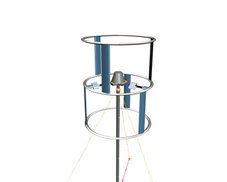
Wind-Sail has developed a patented vertical-axis wind turbine that delivers breakthrough performance, cost, and operational benefits specifically optimized for urban-scale clean power. Based in the Bay Area, California-based Wind-Sail is now seeking venture capital to certify initial 3 kW platform and launch global sales and contract manufacturing.
Wind-Sail Overview
Wind power today is a $27 Billion market worldwide, growing at 40% yr/yr[1], with ever larger turbine systems deployed as utility-scale wind farms. To maximize the power these turbines can produce, these farms are typically placed in the highest wind regions in the world. Yet, most people don’t live in Class 5 wind regions, and furthermore, most people in urban environments would not want or could not feasible deploy these massive systems – with spinning blades that approach the speed of sound and are bigger than Boeing 777 airplanes.
Wind-Sail was founded on a belief that significant wind power opportunities exist in for urban-scale small and mid-range power applications (1-3 kW, 30-50 kW systems). However, to be successful in urban environments, new approaches, new formats, and key new features were required to make wind turbines practical for city applications.
Based on scientific and engineering research funded by Lawrence Berkeley Labs, Wind-Sail has innovated a vertical axis wind turbine (VAWT) with best-in-class aerodynamic efficiency and performance features for commercial and urban-scale power applications. Our competitive advantages are driven by these key urban benefits of the VAWT:
§ Optimized Efficiency: Highest CPP (40%) of any distributed wind power system. System is omni-directional, capturing the gusty, variable winds that are typical in urban and light/medium wind regimes.
§ Smaller Footprint: Compact design ideal for constrained environments in industrial, urban, campus, and hybrid solar applications.
§ Innovation Through Simplicity: System is easier to manufacture (fewer parts).
§ Scalability: Will scale from 1 to 50 to 500 kW formats.
§ Operational savings: more reliable with one bearing set, more durable with slower spinning blades, and less maintenance than any turbine on the market today.
§ Multiple configuration options: Turbines can be stacked, installed sideways, upside, or at any angular dimension for applications where space constraints or wind conditions necessitate new formats. In addition, because there are no significant blade clearance issues below the turbine, system can be installed in certain applications without costly towering installations or foundations.
Wind-Sail’s turbine technology has been computer simulated, water and air tunnel tested, prototyped, fine-tuned, patented, and now scaled to successful working models in 1, 3 and 30 kW formats. One of the working units has a small video demonstration at: www.wind-sail.com
Wind-Sail Team
Wind-Sail's executive team has over 40 years of experience in the engineering, production, sales and executive management in electric motor and power component industries.
• Rich McClellan, PhD, CEO
Veteran executive of 3 electronics startups sold to Parker-Hannifin, Motorola, Printronix. Doctorate and is industry expert in power electronics.
• Rick Halstead, CTO
Power industry innovator with extensive management, sales, and technical development expertise with alternators engineered for harsh environs.
• Vladimir Krivopickj, PhD, Technical Leader
Leads core blade/turbine design team. Aerodynamic engineer with
30 years of experience in
• Chris Larson, Project Leader
25 year veteran of PG&E with project management experience across plant, grid, substation and environmental projects in the Bay Area. Leads the site management and permit applications for our Treasure Island install project.
• Jeremy Stieglitz, Marketing & BD
15 year high technology veteran with experience launching and growing product lines of $2M-$800M for Microsoft, RSA, and Cisco Systems.
Competitive Position
There are several companies selling small scale wind turbines based on traditional, horizontal axis propeller based turbines, including Bergey and Southwest Wind. There are also a growing number of VAWT turbines, primarily selling in
Patents protect key innovations in the aerodynamics of the blades, vertical orientation of the system, the system wind loading and blade configurations, aerodynamic ring structure, the alternator, and the electronic control optimizations for distributed wind.
Markets
The global market today for distributed wind power is today a $400M market, and is forecasted to grow 10x over the next 10 years to $4BN. According to the American Wind Energy Association (AWEA), “to date about 110 MW of “small-scale” community wind capacity is installed in the
Needs from Investors:
Wind-Sail has had no external investment and corporate structure remains flexible. We are seeking $1.5m-$2m in seed/angel funding to establish key first customer deployments in strategic and tactical sales opportunities. An additional investment of $5-$7M will be sought to grow the launch team, scale contract production, establish global distribution and sales offices, and expand sales and marketing programs worldwide.
Summary Contact Information:
(650) 575-2317
Wednesday, March 14, 2007
Welcome To Wind-Sail
Wind-Sail is developing a breakthrough vertical axis wind turbine optimized for capturing wind power where we work and live. This site will contain observations around the clean energy technology and supply issues, venture funding cleantech, and specialized expertise in vertical axis wind technologies, applicaitons and marketplace.
Subscribe to:
Comment Feed (RSS)