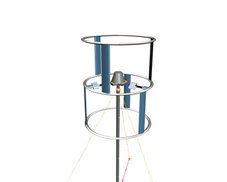
Busy news day. Big, front of business pages article today in the New York Times on wind power in America. Very sweet.
Showing posts with label Policy Matters. Show all posts
Showing posts with label Policy Matters. Show all posts
Friday, June 1, 2007
NYTIMES PIECE ON WIND

Thursday, May 31, 2007
Bush, Kyoto, and Global Warming
Today, there is news that Bush calls for global goals for emissions.
Following up from my post below about Energy Demand and Productivity data from the McKinsey report, this news is quite timely. Analyzing the present carbon emission contributions and growth rates across the globe, - and seeing the shared and increasingly distributed extent of global carbon emissions - you get a sense that the U.S. rejection position on Kyoto wasn't as dead wrong as the environmentalists and liberals (myself included) were first thinking.
As I see it, the ability to globally align an effort to curb carbon emissions comes down to two very simple, conflicting notions.
Notion One: Since the developed world did most of the harm in CO2 emissions to date, and continues to pollute the most per capita, the burden to improve and fix the problem lies squarely and firstly there, in countries like the United States, Germany, United Kingdom, Canada, and Japan.
Notion Two: We're all in this together. Regardless of how we got here, we need to look at the straightforward math of who's putting out CO2, how much growth will occur in each polluter country, and a means to reduce those growth rates across all countries. That math says that the biggest gains/improvements can be made only when we are reducing carbon emissions in the biggest emitter countries.
The Kyoto accord was very much in alignment with Notion One - developed countries pay now, and that China and India get a "free pass" until the next round of cuts next time.
But what was the right approach? This is a hard dilimmna, and I've shifted my view CLOSER to the Bush administration. One can say that Notion One has progressive justice and ethics on it's side, but I am seeing a new fairness and efficiency in Notion two. Maybe it's just becoming a parent, and arbitrarily putting all my kids in "timeouts" regardless of how, when, and who started the latest ruckuss. The point being, looking to the past and trying to establish total fairness is secondary to fixing the immediate problem at hand.
In fact, if your trying to fix the problems of emissions with one set of countries obeying one set of rules, and then allowing a different set of countries to have no rules, you end up with those countries actually growing the problem you are trying to regulate and fix. That's broken.
Is it fair to crimp on China's growth when they consume 1/20th the power of Americans?
Perhaps "next time around" the solution lies in both sides coming to a compromise approach. Something that balances the fact that sacrifices have to be shared, reduction progress has to be made across the globe, AND that those sacrifices are somehow fair-weighted to both past pollution and present per capita considerations. Heck, a similar compromise approach solved the constitutional crises in forming America in the 1770s by giving smaller States equal representation in one governing body - the Senate, and giving the bigger, more populous states more representation power int e House of Representatives.
Maybe the way to Kyoto isn't through Montreal, but in a bicameral emissions reduction math - everybody pays, and the biggest polluter hogs pay more?
Great Energy Demand Side Data and Presentation
Every once in a while, there is a piece of energy news/reporting that is so good, so clear and compelling, I feel like emailing it to everyone I know. Nowadays, fortunately for them, I don't have to do that anymore, this is what a blog is for :)
E&ETV has posted their May 17th presentation by McKinsey Global Institute on their recent report, "Curbing Global Energy Demand Growth: The Energy Productivity Opportunity".
This is a MUST watch video, and I recommend that open a second browser window so you can see the slides that are being discussed by separately clicking on the SLIDES here:
The most fascinating aspects of this presentation to me were:
#1. Who Knew? Who knew that in the next 20 years, it’s the “
#2. Bitter irony: Energy prices go up, but demand doesn’t necessarily go down globally? Because those very same middle easterners have so much more money/consumption that they EQUAL the diminished demand from the developed world.
#3.
Wednesday, May 16, 2007
People Moving and Power
Two interesting web connections on the movement of people on the planet and in the United States.
Thanks to Paul Kedrosky for pointing me to this very cool, flash based global map of where people are moving on the planet. Surprised to see the relatively low movement out of China. I suspect that the data has been normalized to mean percentages of inbound and outbound movement. Must be, as China would presumably have orders of magnitude more activity than Peru without normalization. It's a pity that Asia-to-America and Asia-to-Great Britain traffic goes across the rest of the map, as it's hard to discern which dots are going where between and betwixt these edge cities. Someone needs to redo with a "wrap" function so that we can separate out patterns of East-to-West and West-to-East from any country a little easier.
With richer specific data, jonrayjay has parsed U.S. Census bureau data to come up with a notion of the Great Decline of the Coastal Megalopolises. Putting my All Power Is Geography hat on, this population shift in is mostly a net neutral impact for solar, and in general, quite a bad thing for wind. As you can see from even the cartoon picture here, leaving the coasts means leaving some of the best wind resource in America. On the positive side, it means a lot less consumption of heating fuels in the winter. On the negative side, it also means a lot more stain on already constrained internal water resources, and more power to power hungry AC. (Actually, AC consumption and it's strain on the grid is floating north as well.)
Tuesday, May 15, 2007
Nothing For Free

So, after trumpeting the Montreal Protocol as an umitigated success in reducing CFCs in the atmosphere and "saving the Ozone layer", I should have known that nothing comes for free. Turns out, according to USA Today article that the replacement coolants — hydrochloroflourocarbons— are potent greenhouse gases that harm the climate, up to 10,000 times worse than carbon dioxide emissions.
O well, maybe we can't get to Kyoto from Montreal after all.
Monday, May 7, 2007
Kyoto by way of Montreal
 Last night, I was talking with a friend about market forces and market failures of carbon emissions. Specifically, we agreed that there is no way that you can price the cost of carbon emissions sufficiently enough to curb the problem on a global scale. Beyond this market failure, we'll most certainly need an enlightened set of government leaders across the globe to initiate hard decisions to change our trajectory. No easy task.
This morning it got me thinking... what does government do well? When does government dictate a policy based on what is right, and then solve the market/economics/pricing of that decision later, especially on an international scale. Well, warfare seems to be one. But what about the environment? And then I found my first answer. CFC emissions. Remember those nasty, ozone-depleting freons that lofted up into the air, turined into chlorine gas, and then wreaked havoc on O3, especially over the polar caps?
The leaders of the world did manage to agree, and drive through policy, substantial change and mitigate the CFC problem. Twenty years after the signing of the Montreal Protocol, CFC emissions are below 20% what they were in 1980, and though it's a slow path, scientists are optimistic that the hole will be completely gone in 50 years.
What was magic in Montreal and how can it help get us to "Kyoto" (a successful, international government campaign to reduce carbon). One quick search on Google and I found this writeup from MIT on Lessons Learned From the Montreal Protocol for Global Warming.
It's a decent read, though personally, I would like to have seen a little more concrete details on how the Protocol was able to push through policy in light of contested scientific data, as well as, which came first, the threat of CFC bans from government, or Dupont's market englightenment that a chemical replacement strategy could be profitable.
In fact, it doesn't matter which came first, because you get a sense that Dupont had sufficient market share and technical know how to make a profit ON the banning of CFCs. I'd say the opposites are true on global warming. No one entity has any controlling share of carbon emissions, and worse, the biggest polluters on the planet (the citzenry of the planet using billions of individual cars, stoves, tree-cutters, etc. ) have zero ways to make profitable moves someplace else, and real, direct costs to doing anything but burning easy and cheap fossil fuels.
The article closes with it's most relevant point, and yet, did little to draw out how the Montreal Protocol tied the science to the policy as quickly and effectively as they did.
- The effectiveness of any strategy on global warming will depend on how well it creates new markets. That much was learned from the Montreal Protocol. But perhaps the greatest lesson is also one of the simplest: when science shows us a looming environmental disaster, we need to act quickly and decisively, regardless of the economic or technical uncertainties.
What we need is an "ozone hole" picture for global warming, a one image graphic that can speak to the impending danger, as well as the comprehensive impact of global warming. Most of us have seen that Al Gore image of rising temperatures and peak years of hot weather. But as a chart, it's not as emotional as a picture, and there are "outlying" years that also create doubt and angles for obstructionists. (such as "why didn't it get warm in the 1950s when carbon emissions took off, etc. etc.). I'm on the hunt, stay tuned...
Tuesday, April 24, 2007
America's Power Footprint

I finally had a Eureka moment today in understanding the 'power footprint' data in the United States. The pie chart above shows which constituents are burning the most coal/oil/gas power in the United States for 2000. What I long struggled with was the appearent "double counting" between the "Electric Power" category, and the household, commercial and industrial categories. Weren't these users also the same end users of "electric power" ???
My Eureka moment came from the footnote on this chart. Yes, these users ALSO use electric power. In other words, natural gas electric plants + coal burning electric plants make up the Electric Power category, and your John Deere, and backup diesel generator, and propane forklift whizzing around Costco make up your residential / commercial / industrial consumers of fossil fuel power.
In some ways, there is a notion of double-counting still going on, because that "electric power" category ends up being consumed in houses, builidings and factories. But in terms of managing future carbon emissions, and pricing systems for carbon, the pie is useful as a starting point in who's going to pay, and what impacts a tax / pricing scheme will have across the economy.
Fortunately, others have appearently had similar thinking, from the National Commission on Energy Policy's Carbon Pricing Report, here's the "no double counting version" of that same pie chart that accurately breaks down the end uses from the Electric Power category. People should be required to show this version of the energy footprint chart to save others from needless confusion.
Friday, April 20, 2007
Renewable power paybacks, Part One
Anyone who has ever contemplated installing solar panels or wind turbines to "go green" and offset their electricity consumption with renewable power has run into the payback model. The model measures how many years before the money you put into a system is "earned back" in the savings you make from offsetting your electric bill with by generating local, renewable power.
It's the primary way that the costs of installing clean power are measured and here's how it works.
To calculate your payback model, you'll need to know the following inputs:
1. Cost of System
2. Rebates
3. Expected Yearly Power Output of System
4. Today's Grid Tie-In Price For Local Power Output
5. Rate of Increase in Power Prices
6. Cost of Money (Interest Rate)
Many of these inputs have a high degree of regional variability, which is one of the reasons that payback models seem complicated. Certainly the install costs, power output, local power price, and rebates can all change depending on what State you live in. For my model, I will use California as my reference. California in many respects is the "Best Case" model for renewable power, because the rebates, power produced, and power purchased by the utilities are all some of the highest in the country. It's also more expensive to install, but those other benefits usually outwiegh that higher expense.
Let's Now Compare Power Payback Models for Home-based Solar (3kW) and Wind (3kW)
#1. TOTAL SYSTEM COST
3 kW Solar System (Installed Cost) : $28,500 (aka $9.50/watt is typical in CA)
3 kW Wind Turbine System (Installed Cost): $20,000
ASSUMPTIONS: I am using conservative numbers for each of these. In theory, you might be able to get these installed for a lower cost point.
#2. REBATES
SOLAR SYSTEM COST AFTER REBATE: $17,100
WIND SYSTEM COST AFTER REBATE: $12,500
The State of California offers substantial rebates for both large and small commercial solar electric systems through the California Solar Initiative (CSI). Depending on the size of your facility, you will qualify for either the Expected Performance Based Buydown (EPBB) or a Performance Based Incentive (PBI) program.. These rebates can cover as much as 40% of the total system cost. For my math, I'll assume that the rebates get you the full 40% cost reduction.
Fortunately, the State of California is also quite aggressive with Wind Turbine system rebates. The California Energy Commission is offering cash rebates on eligible grid-connected small wind renewable energy electric-generating systems through its Emerging Renewables Program (ERP). This rebate for wind provides $2.50 up to the first 7.5kW nameplate systems.
#3. EXPECTED YEARLY OUTPUT
Solar: 3,780 kw/hrs per year
Wind: 5,940 kw/hrs per year
One of the benefits of solar power over wind power, from a consumer standpoint, is that it's easier to calculate expected yearly power output, and the variance in total power produced is lower (how much your calculation could be off should be low). There are quite a number of complexities even for determining solar. See a good summary of factors afftecting solar power production here.
I've written about nameplates versus total power produced starting here, but to calculate the total power produced for wind is something I will leave for a different blog post. It's probably even more complex than the solar reference above, and there is a much higher degree of variance, site to site, in the same geographies (even same site depending on where the system is installed, shading, height, etc.)
#4. California Residential Retail Power: 13.07 c
I used the PG&E rate available from the California Energy Commission weighted rates table here.
#5. RATE OF INCREASE IN POWER PRICES
1%, 5%, 20%
Depends on scenarios into the future...In some respects, this is the most important variable in the equation, and yet, it's the least known to us today. If you think long term energy prices will remain where they are today, you probably won't be purchasing solar or wind. The math on today's cheap energy prices "doesn't add up." When people do buy these systems, it's because they either believe long term prices are headed much higher, or they are price-insensitive and can afford to go green regardless of the economics. When I model out paybacks, I'll use three scenarios here: 1% (less than inflation), 5% (present status quo), 20% (bad moon rising).
#6. Cost of Money
5.3 %
I used BankRate.Com and assumed a best case, long term money market account with $10k minimum.
So, we're now ready to go. Check back for Part Two, how to run the model next.
Tuesday, April 17, 2007
Contrasts

Today, friends emailed me almost completely opposite views on the future prospects of cleantech. From CNN, we have a bullishly 'anti-green' interview with EXXON CEO Rex Tillerson: "I don't have a lot of technology to add to moonshine," says Tillerson of ethanol.
From the New York Times, we have a very long piece by Thomas Friedman on the power of green as a "geostrategic, geoeconomic, capitalistic and patriotic" way for America to proceed.
From Tillerson, we get the unabashed champion of capitalistic pursuit of profits in oil tech. And based on Exxon performance, he runs that business very well.
From Friedman, we get some very compelling business, political, and environmental reasons to pursue green as a stratetic initiative. He is dead right to say that government must find a way to price the carbon emissions these fuels put into the air. But he totally, utterly misses when he states that: "presidential candidates need to help Americans understand that green is not about cutting back. It’s about creating a new cornucopia of abundance for the next generation by inventing a whole new industry."
I don't agree. I think the mindset that says that our present consumption in the First World is supportable going forward as an a priori to considerations of green and sustainability is dangerously wrong headed. Unless and until we can find replacement technologies that provide the same (or more) aubundance than dirty tech provides, it is NOT at all clear that green can mean no hard trade-offs or reductions.
It's really two problems: how to shift away from dirty tech and maintain an acceptable quality of life (not necessarily growing aubundance for the rich), and how to bring up the worldwide quality of living for the vast billions living in abject poverty without using those easy, dirty methods to get there. Of course I want more aubundance, but I suspect that cheap, dirty fossil fuels provide a bigger pie than sustainable, green practices. Maybe we must accept a smaller pie? I want my politicians brave and capable enough to see and communicate that to the American people.
Tuesday, April 10, 2007
Lean and Clean San Francisco

With a $100M bond, and a goal to grow renewable power from 2 MW to 35 MW in a decade, San Francisco is aggressively trying to establish itself as a Green City leader. To speed up the deployment of renewable power in the City, the Public Utilities C0mission recently posted a Request for Information (RFI). (link)
I've written in the past about Wind Permits, and seeing RFIs like these are exactly the kinds of efforts required to accelerate and tear down procedural and policy hurdles to clean wind tech.
From the RFI:
"While San Francisco has a fairly high rate of renewable-power installation relative to other US cities, these number fall far short of the ambitious goals proposed in the City’s 2002 Electricity Resource Plan. The plan called for 50 megawatts of installed solar PV and 72 megawatts of local distributed generation capacity city-wide by the end of 2012, as well as 150 megawatts of wind power located outside San Francisco. "
In fact, Wind-Sail's first pilot install on Treasure Island is considered as a "municipal" project, and it is our hope that we can begin to accelerate the permitting and ordinance issues by working directly with the City and SFPUC to "streamline" permitting. From our response:
"The single most important accelerator for our business is to demonstrate the feasibility and practicality of our systems in urban environments. As such, we are very flexible to leasing, donating or partnering with SFPUC to provide these turbines for
Addendum: Nathan Nayman of the SF Examiner also has an additional write-up for the effort here. (link)
Tuesday, April 3, 2007
Are Green Robes Next

In a stunning ruling expanding EPA authority to regulate carbon emissions, the Supreme court handed environmentalists, and by extension, the cleantech industry, a very generous prize yesterday. I am surprsied that more cleantech bloggers are not recognizing the importance and benefit that this ruling will have for our industry. Paul Kedrosky was the only prominent blogger to chime in here. (link)
Specifically for cleantech, the ruling means that:
1. What begins with more emission controls for Duke Energy - the heart of this case - could be easily extended and expanded into carbon taxes and increased fee structures for carbon emitters. Whether market-based or by regulation, anything that increases the cost structure for coal or fossil fuel power and transportation is a boon for cleantech.
2. Another foundation stone towards a real and valued carbon credit trading system.
3. A more naunced benefit from this ruling is a reinforcement that States and environmental groups have sufficient "standing" to bring these cases forward. This was the key "objection" by the conservative bench; Scalia, Roberts, Thomas, and Alito wanted to limit and essentially remove the court's participation in this matter (and most environmental matters if Scalia had his way). They indicated in their dissent that Congress and The President were better "deciders" on the issue. Thank goodness they were overuled.
The text of the bill is online here. (link)
For now, green is the new black at One First Street, DC (Supreme Court's address.)
Monday, April 2, 2007
Small Wind Tax Credits
The U.S. Congress is considering a new blockbuster bill to support small wind. The size of this federal tax credit is _massive_ and could dramatically change the pace and acceptance of small wind in the United States.
FROM AMERICAN WIND ENERGY ASSOCIATION NEWSLETTER:
"Tax Credit Bill Now Introduced in House
A bill was introduced yesterday, March 29 by Reps. Earl Blumenauer (D-OR) and Tom Cole (R-OK) in the House of Representatives that would provide an investment tax credit to consumers looking to purchase small wind turbines. This bill, H.R. 1772, comes on the heels of an identical bill that was introduced in the Senate last February (S. 673). Both bills call for the following:
- A tax credit of $1,500 per ½ kilowatt (kW) of capacity for a small wind system. The proposed credit would have no cap and would be available for 5 years for all wind systems 100kW in capacity and under.
- Carry-over of credit: In the event that using this credit puts the consumer’s taxable income below the minimum threshold, this provision allows the unusable excess credit to be carried over to the next tax year. This essentially allows a consumer with a low annual income to take full advantage of the credit.
- Accelerated depreciation of three years, rather than the standard 5 years.
Go Distributed Wind Power!
Thursday, March 29, 2007
What Would Karl Rove Do (W-W-K-R-D)
The White House is in the news a lot these days. I am going to show how all of these stories have a similar, Total War backdrop to them, and then examine what this Total War approach might look like for Clean Tech:
- The 'Surge' in the Iraq war and Congress voting to mandate timeframes for troop withdrawals
- The Attorney General and the politically based firings of well qualified U.S. Attorneys
- The General Services Administration is being investigated for inappropriately steering and guiding resources based on politics
- The censorship of environmental and climate scientists by political appointees.
- The destruction of civil liberties - either our own or our prisoners/enemy combattants
The present Administration is not just trying to promote an agenda - all administrations should - the present Administration is trying to destroy systems that do not align with its view. By destroy, I mean that literally. Take the battle to the EPA, the Clean Water Act, appoint a fervent religious extremist as your head of Justice, remove lawyers that don't prosecute (persecute) your political enemies, launch a "surge" of troops to Iraq in the months following a dramatic political rebuke of your war policy and execution.
In fact, if you look at any successes in the last 6-7 years from this administration, the vast majority of those haven't really proven to be effective in the promotion of any agenda item. They aren't succeeding by promoting compassionate conservativism, or increased religious conservativism in our schools, thoughts, conduct, as much as they are absolutely dominating the battle to DESTROY counter views.
Quoting from Wikipedia: Total war is a military conflict in which nations mobilize all available resources in order to destroy another nation's ability to engage in war. It's history can be traced to either World War One, The Civil War, The French Revolution, and depending on perspective even all the way back to the Pelopennisian War.
It's not really a complex notion or theory. It's simply the notion that you create so much pain, harm and destruction, unbound by any ethics, morals, or legal parameters that the result is permanent elimination of your enemy. In total war, your enemy isn't jailed, or weakened, or overthrown, but annihilated. And that annihilation isn't just the soldiers on the battlefield, it's their parents, cousins, children, their homes, fields, crops, and livestock, poison their wells, fry their electric grid, mangle their bridges, corrupt their culture, outlaw their history, ban their communications, and shatter any independent thought or peace of mind from ever taking hold again.
In January, Vinod Kholsa published a Wall Street Journal Editorial advocating a "War On Oil." In that piece, he makes the case for a war on oil to fund cellulosic biofuels, and for transportation fuels, he's probably right. But why stop at a battlefield war...
This week, the New Yorker has a book review on Slaughterhouse - The Idealistic Origins of Total War. The review examines the notion that Total War has it's start in Napoloeonic times, but more interestingly, that the original designers of total war were idealists. That war could be approached as a 'means to end all wars.' In other words, don't just go to war on battlefields with soldiers, but create a war system so massive, and so ugly, that no one would repeat it. (That no standing armies could be repurposed to start anew.)
In thinking about idealistic uses of total war, war on oil, and the complete and total war footing of the present administration, I am wondering about whether there is any relationship here to the future of cleantech. Specifically, what would an idealistic Total War approach to cleantech look like? Would it be beneficial? What would this war have as weapons and how total and comprehensive could it be. Are we to continually do 'battle' with shale oil, clean coal, nuclear and the like?
Total War on Cleantech: A comprehensive, dedicated, focused, many angled attack on all aspects of dirty tech. Or, more simply, if Cleantech were his agenda, Just what-would-Karl-Rove-Do? (WWKRD) (which strangely looks a lot like awkward :)
Such an approach wouldn't be an extension of our efforts today via the active promotion of renewable energy programs - and the moral, environmental, and business benefits from that development. But rather, Cleantech as a destroying force, the armed battle and aggressive, attacking, destroying, take no hostages, leave no stone unturned, have no morals, compunctions, qualms or ethics about tearing down and devastating the dirty tech alternatives we presently rely on. (primarily fossil and nuclear fuel approaches to energy.)
In fact, just as the administration has proven vastly more capable in destroying counter agendas, there is a case to be made that cleantech promotion is _harder_ than ditry tech wars. I gaurantee Karl Rove wouldn't be crying at TED or testifying the moral imperative to Congress. He'd be stirring headlines and launching daily attacks on toxic poisonings, terrorist funding, bribery charges and anything and everything else wrotten in Big Oil.
A Total War approach to Clean Tech would require:
- Hostile action on fossil fuel technologies, past, present and future.
- Hostile action on supply lines of fossil fuels (boycotts, new regulations for shipping, etc.)
- Hostile action on carbon emissions (laws, taxes, fees, bans)
- Hostile action on anything status quo (e.g. Who knew the Clean Water Act should be undercut... Karl Rove Did!)
- Hostile action on businesses engaged in dirty tech.
Is there a Karl Rove in cleantech's future? Do we need a radical zealot that doesn't treat cleantech as an enlightened choice, or a moral imperative, but rather, a a viscious, cut throat, to the death battle where every piece of resource, money, direction should be crushingly dominated and distorted to the cleantech view?
I don't know. I suspect that IF we get to cleantech, it won't be via Total War primarily because it requires administrative/political effort from the very same people betrothen to an extremely well funded and massive Oil Lobby.
I'm expecting supply challenges from Big Oil / dirty tech sooner than any real war footing or moral imperative to go clean...
Monday, March 19, 2007
Distributed Wind in War zones
Perhaps in an irony of ironies, our Middle East military forces, sent to protect our "strategic assets" (re: our oil under their sand), are paying an extraordinary high price to ensure the safe delivery of that fuel to our troops.
According to a report in the Christian Science Monitor, nowhere on the planet are the rising costs of petroleum and fossil fuel energy supplies as acute as they are for Uncle Sam's Army:
• Until recently, the Army spent about $200 million a year annually on fuel, but paid $3.2 billion each year on 20,000 active and 40,000 reserve personnel to transport it.
That was before $70-per-barrel oil. In the spring of 2006, the Defense Energy Support Center reported the US military used about 128 million barrels of fuel last year, costing about $8 billion, compared with about 145 million barrels in 2004 that cost $7 billion.
I don't know if a wind-driven humvee would make sense, but at $300 a gallon, and the human risks of delivering a highly explosive fuel system into harsh regimes, I gaurantee that a $20,000 3kW system for high wind locations such as remote camps in high-wind driven Afghanistan mountain ranges starts to look attractive...
Thursday, March 15, 2007
Wind Permits
What happens when your technology startup is inhibited by factors completely outside the realm of technology? In small wind, the number one inhibitor to market success is the difficult siting and permitting process for installing wind turbines in anything from residential to utility scale projects.
Small wind power has this problem in a particularly acute way, as there are painful diseconomies of scale for the little guy. Yet, where it is windy, wind turbines are presently 5-10x more cost effective than solar on a yearly $/kwhrs standpoint. And yet, getting new users or even solar installers excited about using wind turbines is very very difficult. Even when you can find a motivated buyer with good wind resource, budget, and knowhow, you are still looking at a permitting and siting process than can take months to years.
Don't believe me, just look at the advice from the American Wind Energy Association on how to get started...
- Find out what zoning regulations apply to appurtenant, or non-dwelling, structures on your property. Ask if small wind energy systems are specifically addressed by local ordinance, and if so get a copy of the ordinance. You'll need to know the permitting procedures and find out what documentation is required for your turbine. You may have to submit a structural plan drafted by an engineer, but documents from your turbine manufacturer or dealer may be enough. (A checklist of common permitting issues is available for California residents.)
Just no fun at all...
If wind power is going to make a serious contribution on the local scale, the political and regulation environment is going to have to dramatically change how small wind systems are controlled, regulated and permitted. Part of this will come from an ecosystem of installers, manufacturers, local power utilities that should be motivated to see more local power gen, but I suspect a bigger push needs to happen in the political/legislative/municipal realm. And a final part of this can come from systems that don't spin big blades at 300 miles per hour :)
My thinking on this matter is that LEED may be a good place to start driving this evangelism. I'll keep the audience posted to future developments within that body and others to see if public policy can shift to easily support this compelling clean energy source.
Subscribe to:
Comment Feed (RSS)