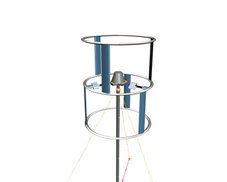
The National Academy of Sciences has posted an Environmental Impacts of Wind-Energy Projects report. The report found that [wind turbines had] "no evidence of significant impacts on bird populations." In particular, the report sets bird kills in context by examining the relative harm to birds by common man made environmental and ecological impacts. That data can be found here.
In a nutshell, wind turbines have led to the untimely deaths of approximately 20,000-38,000 birds, compared to the roughly 100,000,000-900,000,000 birds killed by hitting buildings. (Note the extra zeros). This just shows just how patently nonsensical, irrational, and politicized the notion of windmills killing birds was from the get go. (By the way, for the purposes of the chart in this entry, I had to cheat and change the 28,000 value for turbines to 280,000 just to get that sliver blue line to appear in the chart, relative to the scale of 500,000,000 for building birdkill.)
Tuesday, July 10, 2007
Bird Kill

Tuesday, June 19, 2007
More Maps! Real-time Wind Speeds

Any long time reader of this blog knows that I am an aficionado of maps. A good place to get started with my cartographic pursuits is at my All Power Is Geography Series.
Wind power is only economical in "really" windy locations. If you are building big turbine wind farms, that means that the wind is constantly blowing above 25-30 mph (What the industry calls Class 5 and above wind speeds). That's windy enough to blow your cat end over end, forever. It's that windy only on the coasts, better yet offshore, on the edges of the great lakes, on top of mountain ranges, and in a central sliver of the plains from the Dakotas through Texas. (In fact, it's so NOT windy in the Southeast that Senators from that region are claiming that the present Senate energy bill with renewable portfolio standards is an income depletion tax to wind-endowed regions elsewhere, sorry Southeast.)
For those wondering about wind power for metro wind applications (residential/commercial/municipal use), we don't need the extreme winds above, but we still need a "good" wind resource. What is a good wind resource? It's a place that the wind blows quite often at 20 mph, and sometimes faster to 30-40 mph (What the wind industry calls Wind Classes 2-4). So, where does the wind blow like that?
Fortunately, we can piggyback from the wind sailing/surfing community to get real-time data.
Check out iwindsurf for some very cool, real time and forecast maps of wind speeds for your region. (Shown is California map, where green color would make for effective distributed wind power. )
Monday, April 23, 2007
On Aesthetics, Part Two
In the past, I've written about factors outside the control of Wind-Sail, such as Wind Permits, that may directly impact our success. Another one of those factors, that clearly plays a role in future trajectories for distributed wind is Aesthetics. Specifically, much of today's buying public in America would be concerned about the visual impact of turbines, and perhaps more importantly, whether 'others' such as neighbors and future buyers would be put off be those visual aesthetics of a turbine on their property.
To me, aesthetics are more about past precedence and timing than about intrinsic beauty or not.
Past Precedence
Would anyone tolerate the aesthetics of transmission lines if they were new?
And yet, there are literally millions of these populating our landscapes because we had to have them for our power delivery. Of course, there continues to be concerns today about the safety of these transmission systems, but you don't see a lot of people making the case on the aesthetics of these. They've gotten used to them. or more specifically, there is no alternative to having them.
That's what I mean by power crunch mode, or carbon crunch mode. Someday, we could very well see the power utility mandate the local use of turbines, panels, geothermal, etc. because they'll have no traditional alternatives.
Timing
To me, nothing better exemplifies the role of timing in aesthetics than the Eiffel Tower. Today, the tower is the very epitome of European elegance and design. in fact, the tower is the single most recognized landmark in Europe. Property prices in the 7th arrondissement are some of the highest in Paris, no doubt aided by the appeal of the Champs de Mars and La Tour Eiffel. Yet, it wasn't always this way... Here's an excellent history of the early struggles Monseir Eiffel faced in trying to put up the tower.
From: (Mary Louis King, "A History of Western Architecture" pp.175-195)
The Eiffel Tower was designed by the French engineer and bridge builder Alexandre Gustave Eiffel (1832-1923) for the Paris Exposition of 1889. The tower is 300 m (984 ft) high and consists of an open iron framework making it the highest manmade structure in the world at the time. It was the largest attraction at the Exposition and today it remains the most recognized structure in all of Europe.
It was nearly never built.
After being awarded the contract to build the tower, Eiffel discovered that the Exposition Committee would only grant about a fourth of the monies needed to construct it. Eiffel himself would have to finance the balance. He struck a deal that would make him a very rich man. He agreed to independently find the funders for his tower but he wanted sole control of the tower and its profits for twenty years. They agreed. In a surprise to everyone, including Eiffel, the tower was paid off in the first year.
The deal that Eiffle hammered out is probably what saved the tower from destruction. Many in the arts and civic leaders felt the tower was an abomination. "They have only erected the framework of this monument, It has no skin"
The whole idea that iron -- just iron -- could be beautiful, flew in the face of architectural history. Everyone knew that the great cathedrals and palaces had all been built of stone with the careful craft of ornamentation which adorned them. Sure, iron can play a part in an unseen, underlying structure such had been done with the Statue of Liberty, but to leave it exposed was just poor taste. It was like showing your dirty laundry.
A Committee of Three Hundred was formed and they petitioned for its demise:
Honored compatriot, we come, writers, painters, sculptors, architects, passionate lovers of the beauty of Paris -- a beauty until now unspoiled -- to protest with all our might, with all our outrage, in the name of slighted French taste, in the name of threatened French art and history, against the erection, in the heart of our capital, of the useless and monstrous Eiffel Tower.It may have taken every bit of those twenty years to change some people's minds. All of the other iron buildings built for the Exposition were torn down shortly after (a shame). Today we look upon Eiffel's tower as anything but hideous. Mary Louis King calls it "a monument to nineteenth century architectural engineering and a frank display of structure and material."Are we going to allow all this beauty and tradition to be profaned? Is Paris now to be associated with the grotesque and mercantile imagination of a machine builder, to be defaced and disgraced? Even the commercial Americans would not want this Eiffel Tower which is, without any doubt, a dishonor to Paris. We all know this, everyone says it, everyone is deeply troubled by it. We, the Committee, are but a faint echo of universal sentiment, which is so legitimately outraged. When foreign visitors come to our universal exposition, they will cry out in astonishment," What!? Is this the atrocity that the French present to us as the representative of their vaunted national taste?" And they will be right to laugh at us, because the Paris of the sublime Gothic, the Paris of Jean Goujon, of Germain Pilon, Puget, Rude, Barye, etc. will have become the Paris of Monsieur Eiffel.
Listen to our plea! Imagine now a ridiculous tall tower dominating Paris like a gigantic black factory smokestack, crushing with its barbaric mass Notre Dame, Sainte Chapelle, the Tour Saint-Jacques, the Louvre, the dome of Les Invalides, the Arc de Triomphe, all our humiliated monuments, all our dwarfed architecture, which will be annihilated by Eiffel's hideous fantasy. For twenty years, over the city of Paris still vibrant with the genius of so many centuries, we shall see, spreading out like a blot of ink, the shadow of this disgusting column of bolted tin.9
Although built of iron, it is an inherently inferior material and a single beam is unable to withstand large stresses. That is why the tower appears over engineered by today's standards. Though, from this very weakness its' simple beauty is found. If you look at the tower, the tight lattice work of beams sort of mimic the biological cellular structure of a plant.
In 1855, Sir Henry Bessmer discovered a process of converting iron into steel thereby making it much stronger and lighter, but the evolution from invention to practical use and mass production took many years. Steel would eventually replace iron and would bring the "sky scraper" to the city skylines of America and in 1885 (actually four years prior to the Eiffel's tower), William LeBaron Jenney built the Home Insurance Building in Chicago -- the first sky scraper.
On Aesthetics, Part One
I was at a local cleantech "Earth Day" fair in Atherton CA over the weekend. Had some good discussions with Akeena and Solar City sales teams. I wanted to know about 1.) how they do online internet monitoring for the power delivered from solar, and 2.) whether they saw any opportunities for "hybrid" installs combining solar and wind turbines for a better ROI.
For monitoring, I got some leads and will post an update soon. A quick internet search gets you to Fat Spaniel, but this looks like potentially overkill for my needs to monitor our first 3 kW test install. (please feel free to email me any leads/info on Internet-based remote power monitoring systems.)
For hybrid residential systems, I don't think there is any immediate traction in the Bay Area. For one, there are not that many residences in Northern California in Wind Class 2, let alone Wind Class 3-4 where the ROI and paybacks would be most compelling. Secondly, these guys are so utterly busy, that they can't scale their installers to keep up with present Solar-Only deman. (If it ain't broke...). And lastly, both sets of folks related stories about customers thinking about solar, but abandoning the projects based on "aesthetics."
We're still not in power crunch or carbon crunch mode. In crunch mode, people won't be "picky" about how their power delivery systems look.
Sunday, April 8, 2007
About Wind-Sail

Optimized Urban-Scale Wind Power
Wind-Sail has developed a patented vertical-axis wind turbine that delivers breakthrough performance, cost, and operational benefits specifically optimized for urban-scale clean power. Based in the Bay Area, California-based Wind-Sail is now seeking venture capital to certify initial 3 kW platform and launch global sales and contract manufacturing.
Wind-Sail Overview
Wind power today is a $27 Billion market worldwide, growing at 40% yr/yr[1], with ever larger turbine systems deployed as utility-scale wind farms. To maximize the power these turbines can produce, these farms are typically placed in the highest wind regions in the world. Yet, most people don’t live in Class 5 wind regions, and furthermore, most people in urban environments would not want or could not feasible deploy these massive systems – with spinning blades that approach the speed of sound and are bigger than Boeing 777 airplanes.
Wind-Sail was founded on a belief that significant wind power opportunities exist in for urban-scale small and mid-range power applications (1-3 kW, 30-50 kW systems). However, to be successful in urban environments, new approaches, new formats, and key new features were required to make wind turbines practical for city applications.
Based on scientific and engineering research funded by Lawrence Berkeley Labs, Wind-Sail has innovated a vertical axis wind turbine (VAWT) with best-in-class aerodynamic efficiency and performance features for commercial and urban-scale power applications. Our competitive advantages are driven by these key urban benefits of the VAWT:
§ Optimized Efficiency: Highest CPP (40%) of any distributed wind power system. System is omni-directional, capturing the gusty, variable winds that are typical in urban and light/medium wind regimes.
§ Smaller Footprint: Compact design ideal for constrained environments in industrial, urban, campus, and hybrid solar applications.
§ Innovation Through Simplicity: System is easier to manufacture (fewer parts).
§ Scalability: Will scale from 1 to 50 to 500 kW formats.
§ Operational savings: more reliable with one bearing set, more durable with slower spinning blades, and less maintenance than any turbine on the market today.
§ Multiple configuration options: Turbines can be stacked, installed sideways, upside, or at any angular dimension for applications where space constraints or wind conditions necessitate new formats. In addition, because there are no significant blade clearance issues below the turbine, system can be installed in certain applications without costly towering installations or foundations.
Wind-Sail’s turbine technology has been computer simulated, water and air tunnel tested, prototyped, fine-tuned, patented, and now scaled to successful working models in 1, 3 and 30 kW formats. One of the working units has a small video demonstration at: www.wind-sail.com
Wind-Sail Team
Wind-Sail's executive team has over 40 years of experience in the engineering, production, sales and executive management in electric motor and power component industries.
• Rich McClellan, PhD, CEO
Veteran executive of 3 electronics startups sold to Parker-Hannifin, Motorola, Printronix. Doctorate and is industry expert in power electronics.
• Rick Halstead, CTO
Power industry innovator with extensive management, sales, and technical development expertise with alternators engineered for harsh environs.
• Vladimir Krivopickj, PhD, Technical Leader
Leads core blade/turbine design team. Aerodynamic engineer with
30 years of experience in
• Chris Larson, Project Leader
25 year veteran of PG&E with project management experience across plant, grid, substation and environmental projects in the Bay Area. Leads the site management and permit applications for our Treasure Island install project.
• Jeremy Stieglitz, Marketing & BD
15 year high technology veteran with experience launching and growing product lines of $2M-$800M for Microsoft, RSA, and Cisco Systems.
Competitive Position
There are several companies selling small scale wind turbines based on traditional, horizontal axis propeller based turbines, including Bergey and Southwest Wind. There are also a growing number of VAWT turbines, primarily selling in
Patents protect key innovations in the aerodynamics of the blades, vertical orientation of the system, the system wind loading and blade configurations, aerodynamic ring structure, the alternator, and the electronic control optimizations for distributed wind.
Markets
The global market today for distributed wind power is today a $400M market, and is forecasted to grow 10x over the next 10 years to $4BN. According to the American Wind Energy Association (AWEA), “to date about 110 MW of “small-scale” community wind capacity is installed in the
Needs from Investors:
Wind-Sail has had no external investment and corporate structure remains flexible. We are seeking $1.5m-$2m in seed/angel funding to establish key first customer deployments in strategic and tactical sales opportunities. An additional investment of $5-$7M will be sought to grow the launch team, scale contract production, establish global distribution and sales offices, and expand sales and marketing programs worldwide.
Summary Contact Information:
(650) 575-2317
Wednesday, April 4, 2007
Wall Street Journal On Wind Economics
The Wall Street Journal has a great piece today on the "new math" of renewables and how they are approaching cost-competitiveness with traditional dirty tech energy sources.
..."Wind power stands out as one of the splashiest success stories in renewable energy. Over the past 10 years, as wind farms sprouted around the world, the cost of generating electricity from wind has fallen dramatically.
In 1980, wind-power electricity cost 80 cents per kilowatt hour; by 1991 it cost 10 cents, according to the International Energy Agency.
Today, production costs at the best on-shore sites have dropped as low as 3 cents to 4 cents per kilowatt hour, but are more typically 6 cents to 9 cents, not counting subsidies -- getting closer to the cost of generating electricity from burning coal. In fact, costs are approaching the point where wind power may be able to prosper without subsidies -- currently 1.9 cents a kilowatt hour in the U.S. -- particularly if natural-gas prices stay high.

(link)
Monday, April 2, 2007
Small Wind Tax Credits
The U.S. Congress is considering a new blockbuster bill to support small wind. The size of this federal tax credit is _massive_ and could dramatically change the pace and acceptance of small wind in the United States.
FROM AMERICAN WIND ENERGY ASSOCIATION NEWSLETTER:
"Tax Credit Bill Now Introduced in House
A bill was introduced yesterday, March 29 by Reps. Earl Blumenauer (D-OR) and Tom Cole (R-OK) in the House of Representatives that would provide an investment tax credit to consumers looking to purchase small wind turbines. This bill, H.R. 1772, comes on the heels of an identical bill that was introduced in the Senate last February (S. 673). Both bills call for the following:
- A tax credit of $1,500 per ½ kilowatt (kW) of capacity for a small wind system. The proposed credit would have no cap and would be available for 5 years for all wind systems 100kW in capacity and under.
- Carry-over of credit: In the event that using this credit puts the consumer’s taxable income below the minimum threshold, this provision allows the unusable excess credit to be carried over to the next tax year. This essentially allows a consumer with a low annual income to take full advantage of the credit.
- Accelerated depreciation of three years, rather than the standard 5 years.
Go Distributed Wind Power!
Monday, March 26, 2007
All Power is Geography, Part Two
In my continuing series on All Power Is Geography: Here is a map of the solar resources in America. #1. I am surprised by how non-uniform this map is. There are almost more longitudinal strata (resource changes moving east to west) than latitudinal stata (boundaries moving North to South) , especially in the Midwest region.
2. No clue why Southern Texas is so weak, I guess weather is almost as important as latitude (or else, why is half of Colorado stronger than Southern Florida.)
3. I'd be curious to see where and how the world's hot spots of population densities map to solar resource, particularly for Indonesia, India, and China. My guess is that this bodes well for solar in Mexico City, I suspect it bodes poorly for solar in Tokyo Japan.
Here is the wind resources map for the U.S..
Given the strong resource in the Northeast, I am surprised that there are not more wind power startups or markets there. Sure, we know about the Cape Wind effort/issues. But given Maine's proximity to large power distribution lines feeding Boston and New York, I am particular surprised that the Maine high wind resource is not further developed... ?
Also, just an absolute 'dead zone' for the South East - null white space across entire States.
Lastly, someone, somehow, is going to get clever and do some Google-esque "mashups." I've seen one on the overlay of wind resource and transmission lines (link tbd). Someday, I'll get clever and submit one on Hybrid Resources (where to put Wind + Solar) (installers take note:), I could also see usefulness in Solar/Wind Resource + Incentives/Carbon Credits. These may exist, but I haven't seen them and cannot easily google them...
Tuesday, March 20, 2007
New Clean Tech Trends Report

The new clean energy trends report by Clean Edge research group is out. Considering it's free, it's quite a good high level view of investment and technology trends in renewables with a primarily U.S. focus, and there is the corresponding focus on solar and ethanol as a result. The key trends are also ALL U.S. based, which is a shame as 2006 saw some very interesting dynamics in surging demand and cleantech spending in China and India, European progress on carbon trading systems and legislation, European technology advances across the board, massive new wind capacity put online (15,000MW), and the growing competitive nature of large China PV manufacturing and India wind turbine manufacturer Suzlon, etc. etc.
Of course, one nice surprise is that the report - while U.S. centric - is not as solar centric as so much of the media and investment interest seems to be focused right now. A good all around read, especially for newbies to get a lay of the land.
Booming Mice and Enlarging Elephants, Part Two

The new wind power installed capacity numbers are out, and 2006 was a blockbuster year for wind turbines worldwide.
Some key stats:
* The total market revenue for new turbines: $26 Billion.
* United States #1 in new installed capacity: 2,454 MW
* Germany #1 in total capacity: 20,621 MW
Perhaps more important for the planet, two key trends in 2006 included:
* Asia region grew at a whopping 52%: 3,679 MW
* Wind power in U.S. was second only to natural gas generation capacity: 10,657 MW
On a nameplate basis, we're still adding too much fossil fuel capacity (11,400 MW from fossial fuels in 2006), and only 3000 MW from renewables, but at least on a relative basis, renewables is in the running and starting to be a realizable 'alternative' to the old way of doing things.
Booming Mice and Enlarging Elephants
The Tale of the Booming Mouse and Enlarging Elephant:
A Look At New Power Production For PV Solar and Wind Power in 2006:
There is a very widespread notion, especially in Silicon Valley, that solar energy is the "fastest" growing clean energy source. And various growth statistics speak to 20-40% growth in yearly and decade scale views of both the PV production and installed capacity measures of power.
Of course, there is no doubt that solar deployments, production facilities, and worldwide demand is growing, but some readers may find surprising is the relative growth of various clean tech sources.
According to a newly released report on PV production for 2006 from Solar Buzz,
Global solar added 1,744 MW (nameplate) new installations in 2006, reflecting a 19% growth over 2005 (1,465 MW added in 2005).
Now let's put some things in perspective.
According to the American Wind Energy Association, wind capacity worldwide grew at 32%. But much more importantly, inside the numbers you see a veritable 10x in scale between solar and wind:
Global wind added 15,197 MW (nameplate) new installations in 2006, reflecting 32% growth over 2005 (24227 MW added in 2005).
New Wind Power: 15197 MW
New Solar Power: 1744 MW
Sour grapes from a wind guy? Maybe a little, but I am also amazed at the power of marketing... say something enough and people really start to believe you. The solar contingent has been so consistent in the "fastest growth" aspect of their marketing that even I had to do a double-take on these numbers. My guess is that 9 out of 10 people where I'd live would think solar is adding 10x the new capacity of wind power...
Thursday, March 15, 2007
Wind Permits
What happens when your technology startup is inhibited by factors completely outside the realm of technology? In small wind, the number one inhibitor to market success is the difficult siting and permitting process for installing wind turbines in anything from residential to utility scale projects.
Small wind power has this problem in a particularly acute way, as there are painful diseconomies of scale for the little guy. Yet, where it is windy, wind turbines are presently 5-10x more cost effective than solar on a yearly $/kwhrs standpoint. And yet, getting new users or even solar installers excited about using wind turbines is very very difficult. Even when you can find a motivated buyer with good wind resource, budget, and knowhow, you are still looking at a permitting and siting process than can take months to years.
Don't believe me, just look at the advice from the American Wind Energy Association on how to get started...
- Find out what zoning regulations apply to appurtenant, or non-dwelling, structures on your property. Ask if small wind energy systems are specifically addressed by local ordinance, and if so get a copy of the ordinance. You'll need to know the permitting procedures and find out what documentation is required for your turbine. You may have to submit a structural plan drafted by an engineer, but documents from your turbine manufacturer or dealer may be enough. (A checklist of common permitting issues is available for California residents.)
Just no fun at all...
If wind power is going to make a serious contribution on the local scale, the political and regulation environment is going to have to dramatically change how small wind systems are controlled, regulated and permitted. Part of this will come from an ecosystem of installers, manufacturers, local power utilities that should be motivated to see more local power gen, but I suspect a bigger push needs to happen in the political/legislative/municipal realm. And a final part of this can come from systems that don't spin big blades at 300 miles per hour :)
My thinking on this matter is that LEED may be a good place to start driving this evangelism. I'll keep the audience posted to future developments within that body and others to see if public policy can shift to easily support this compelling clean energy source.